

- Education
- Trading CFDs
- What is CFD Trading
What is CFD Trading and How does it Work
The idea behind CFD is simple, it lets you “bet” on the price movement of an asset without owning it. In this article we are going to explain what that means, how a CFD trade works and what are the risks. Before you continue reading about CFD Trading, you can read another article "What is Forex trading".
Key Moments
- A CFD is a contract between you and a broker. You never own the underlying asset.
- Your profit or loss equals the change in price between when you open the trade and when you close it.
- You can bet on prices rising (going long) or falling (going short).
- CFDs use leverage, which means you control a large position with a small deposit.
What is CFD Trading
CFD trading is a way to trade the price changes of an asset without owning it. You make a contract with a broker. This contract is called a contract for difference. CFD stands for contract for difference, you do not buy a share of a company or a barrel of oil or an ounce of gold - you only agree with the broker about how much the price will change.
If the price moves in the direction you expected, the broker pays you the difference. If it moves the other way, you pay the broker the difference. Because no real asset changes hands, you do not need to store it, register it, or pay the full cost of buying it.
CFDs are available on many kinds of markets - company shares, stock indexes, currencies, commodities such as gold and oil, cryptocurrencies etc..
Trading CFDs offers several advantages that have made instruments so popular over the past decade. Learn about CFD trading steps in the article "How to trade CFDs".
How Does CFD Trading Work
You choose market and direction
First, you pick the asset you want to trade, then you decide whether you think its price will rise or fall. If you expect a rise, open a buy position (going long), if you expect a fall, open a sell position (going short).
Open a trade with margin
CFDs use leverage - you will need to put down a smaller amount (margin).
For example, if a broker offers leverage of 10 to 1, you can control a position worth 10,000 by depositing 1,000. Simple!
Follow the price
After you open the trade, your platform will show your current profit or loss in real time. If you hold a contract that covers 100 shares and the price rises by 2 per share, your gain is 200. If the price falls by 2 per share, your loss is 200.
Closing the trade
You close the trade by making the opposite trade. If you opened with a buy, you close with a sell. At that point, the difference between the opening price and the closing price is settled in your account. You can close the trade yourself, or it can close automatically if you set a stop-loss or take-profit order.
Stop-loss closes the trade when the price reaches a loss level you chose.
Take-profit closes it when the price reaches a profit level you chose.
Understand the costs
CFDs trading is not free, we have spread - it is a small gap between the buying price and the selling price. You start every trade slightly behind because of spread. There is also commission on share CFDs, if you keep a leveraged position open overnight, you will pay a fee, because the broker is lending you the rest of the position's value. Costs are small on a single day, but they add up when positions stay open for longer time periods.
Risk of leverage
Leverage is attractive, and it is also dangerous.
With 10 to 1 leverage, a price move of 10 percent against you wipes out your entire margin.
Move larger than that can create a loss bigger than your deposit, unless your broker offers protection against negative balances. Brokers provide this protection but confirm it before you open an account. Brokers also use margin calls and automatic closing, meaning if your losses grow too large, the broker may ask you to add money or may close your positions without waiting for your decision.
For example a share trades at 50 and you think it will rise. You buy a CFD covering 200 shares, which has a value of 10,000. With 10 to 1 leverage, your margin is 1,000. If the share rises to 53, your position gains 600, which is 60 percent of your margin. If the share falls to 47, you lose 600 in the same way.
 254,697
CFD Example: How to Profit from Rising and Falling Prices
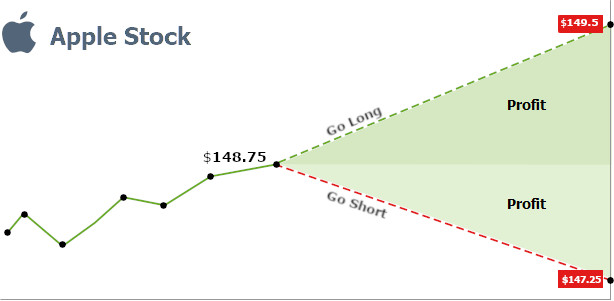
A CFD example is the easiest way to see how contract for difference trading works. You open a position on an asset’s price, and your profit or loss equals the price change multiplied by your position size. CFDs let traders make money in both rising and falling markets.
Short (sell) position: you expect the CFD price to fall. If it does, you profit from the decline, even though the asset is losing value. This is the essence of CFDs: you trade price movement, not ownership.
Long (buy) position: you expect the CFD price to rise. If it does, you profit from the increase.
CFD Example with Apple Shares
Let’s use Apple, because who doesn’t like apples. The Apple stock share price is $343.83. After doing your homework (technical and fundamental analysis), you decide to trade AAPL CFDs on 1,000 shares.
Short CFD example: You sell, expecting a drop. The price falls to 342.33, a difference of 1.50 per share. Your profit is 1.50 × 1,000 = $1,500.
Long CFD example: You buy, expecting a rise. The price climbs to 344.58, a difference of 0.75 per share. Your profit is 0.75 × 1,000 = $750.
If the price moves against you instead, the same calculation applies as a loss. Spreads and overnight fees also affect the final result.
* Note, in this example we are only showing the essence of trading CFDs. Leverage, commissions, stop loss orders are left out on purpose, so as not to load you with extra information.
CFD Trading Explained
CFD imitates the profit and loss for real purchase or sale of an asset. The contract provides an opportunity for trading in the underlying market and make a profit without actually owning the asset.

Let us assume that you expect the rally in metals market to continue and you want to buy 1000 stocks of Freeport-McMoRan Copper & Gold Inc. (FCX), the world's largest publicly traded copper producer. You can buy these stocks through a broker paying a considerable portion (according to the regulatory norms of the Federal Reserve, the initial margin is currently 50% in the U.S.) of the total value of these stocks and take a leverage from the broker for the other part and, moreover, paying commission to the broker.

Instead, you can buy CFD contract for 1000 FCX stocks. To buy this contract you would have to make much lower margin deposit (2.5% of the total value of stocks provided by IFC Markets).
Trade with IFC MarketsTrading Stocks, Commodities, Indices and Currencies
A CFD (Contract for Difference) is a universal trading instrument, which has gained much popularity in the last years. With the help of CFDs, it has become possible to trade on the price movements of various financial instruments, without the need to possess them physically. Nowadays, CFDs allow to trade not only stocks but also major indices, currencies and commodities.
Trading on both Rising and Falling Markets
CFD is a flexible investment instrument. When you believe the market will rise you can make a profit by buying CFD which is known as going long. You can also speculate on falling prices by selling CFDs, known as going short. Holders of open buy positions on Stock CFD get a dividend adjustment equal to the announced dividend payment amount, if they have a long position open on the instrument at the beginning of trading session on the adjustment payment day (coincides with the ex-dividend date). In contrast, the dividend adjustment is deducted from customer's account in case of a short position.
Hedging the Investment Portfolio
If you believe that stocks you own are going to fall in price but still want to hold them, you can use the hedging strategy to protect your portfolio from risks by opening a short CFD position on your stocks portfolio. Your profits from going short in CFDs will reimburse the loss from the falling prices of the assets in your portfolio. You will carry lower transaction costs compared to hedging by selling the physical stocks in order to buy them back cheaper later.

Conclusion
With CFDs you earn from price changes without owning the asset. You can trade in both directions, you can start with a small deposit, and you can access many markets from one account.
Note: If you are thinking about CFD trading, start by learning how margin, spreads, and stop-loss orders work. Try a demo account first, since it lets you practice with no real money. Only trade with money you can afford to lose, and keep your position sizes small until you understand how your own decisions perform.
FAQ
What is a simple CFD example?
If Apple shares trade at $343.83 and you buy a CFD on 1,000 shares, you profit when the price rises and lose when it falls. If the price climbs to 344.58, the difference is 0.75 per share, so your profit is 0.75 × 1,000 = $750. You trade the price movement without owning the shares.
How do you calculate profit or loss on a CFD trade?
Multiply the difference between the opening and closing price by the number of shares in your contract. For a long position, you gain when the closing price is higher. For a short position, you gain when it is lower. If the price moves against you, the same calculation shows your loss.
How can you profit from a CFD when the price is falling?
You open a short (sell) position. If AAPL falls from $343.83 to 342.33, the difference is 1.50 per share, so a short CFD on 1,000 shares earns $1,500. The CFD tracks the price movement, so you do not need to own the asset to benefit from a decline.
What costs can reduce CFD profit?
The main costs are the spread, which is the gap between the buying and selling price, and commission on share CFDs. Holding a leveraged position overnight also incurs a financing fee. These costs are small on a single day but add up on longer-held positions, so the real result is slightly lower than the examples above.
What are the risks of CFD trading?
CFDs use leverage, which magnifies losses as well as profits. A move against your position can wipe out your margin quickly, and your broker may close positions automatically if losses grow too large. Practice on a demo account first, use stop-loss orders, and only trade with money you can afford to lose.
CFD trading instruments at IFCM

 You can study CFD trading more thoroughly and see CFD trading examples in the section How To Trade CFDs Visit Educational Center
Register with IFC Markets Now
Global Access to Financial Markets from a Single Account
